


Every educator working with young readers carries a version of this moment into the last week of school: the child who finally found their stride, who had come alive on the page, will spend two months somewhere else entirely, and September will ask them to start over. The worry is familiar. And, it turns out, it is well-founded.
What the Summer Does to Reading
In educational psychology, the phenomenon has a name: summer learning loss, sometimes called the summer slide. Its mechanism is not complicated — when children disengage from reading over an extended break, the skills they have built begin to recede.
In a meta-analysis spanning studies from 1975 to 1995, Harris Cooper and colleagues found that students lose the equivalent of roughly two to three months of reading progress over the summer, with the highest losses concentrated among children from lower-income households. A subsequent review by RAND Education (McCombs et al., 2011) confirmed the cumulative picture: these losses compound across years and contribute substantially to the achievement gap between advantaged and disadvantaged students.
On the other hand, a meta-analysis by Kim and Quinn (2013) in the Review of Educational Research synthesized 41 summer reading interventions, from structured classroom programs to home-based, child-initiated reading, and found that children who read over the summer showed significant improvements across multiple literacy measures compared to those who did not. Summer reading is not simply a hedge against loss. It is an opportunity for gain that the school year, bound by curriculum and time, rarely provides in quite the same way.
Why Children’s Literature Is Not a Minor Matter
The books most likely to be in a child’s hands over the summer are children’s books — a category sometimes described, without much evidence, as developmentally lightweight. The research tells a more interesting story.
Consider vocabulary first. Building upon classic data from Hayes and Ahrens (1988), later popularized by Cunningham and Stanovich (1998) in ‘What Reading Does for the Mind‘, we know that children’s books contain more rare and sophisticated vocabulary than the spoken language of college graduates — giving young readers consistent contact with words and constructions that conversation, however rich, does not reliably supply.
Then there is the social dimension. In a widely cited study by Raymond Mar and colleagues (2006) in the Journal of Research in Personality, fiction readers showed stronger performance on theory-of-mind measures — the ability to infer what others are thinking and feeling. That research was conducted with adults; Wulandini and colleagues (2017) extended the finding to children aged nine and ten, where reading literary fiction, compared with popular fiction or nonfiction, produced measurable gains in the same capacity.
And there is the question of emotional language. Schwering and colleagues (2021), writing in Affective Science, found that experience with fiction text predicts emotion recognition ability. Their explanation: fiction is disproportionately rich in complex emotional vocabulary — not only the basic, legible emotions, but the harder ones: relief, contempt, anticipation, despair. A child who reads fiction is learning, page by page, to name what other people feel.
What Makes Summer Reading Actually Work
The research on reading motivation points consistently toward three conditions that determine whether children sustain reading voluntarily. Self-Determination Theory (Deci & Ryan, 2000) — a framework built on decades of research into what drives lasting, intrinsic motivation — identifies them clearly, and they are worth naming precisely, because they are conditions educators and families can actively create.
Let the child choose. Autonomy is central to intrinsic motivation. Children who select their own books read more, and with more engagement, than those working through assigned lists. Summer, freed of curriculum constraints, is the natural home for this.
Match the book to the reader. A child who finishes a book acquires something beyond vocabulary: the conviction that they can do it again. Books pitched where the story compels before the language resists build the confidence that makes a reader out of someone who was not sure they were one.
Make it a shared experience. Reading alongside a parent, discussing a story, hearing a book aloud as a family — these are not supplements to reading. They are among the most reliable conditions for turning it into a lasting habit.
Where Vlume Comes In
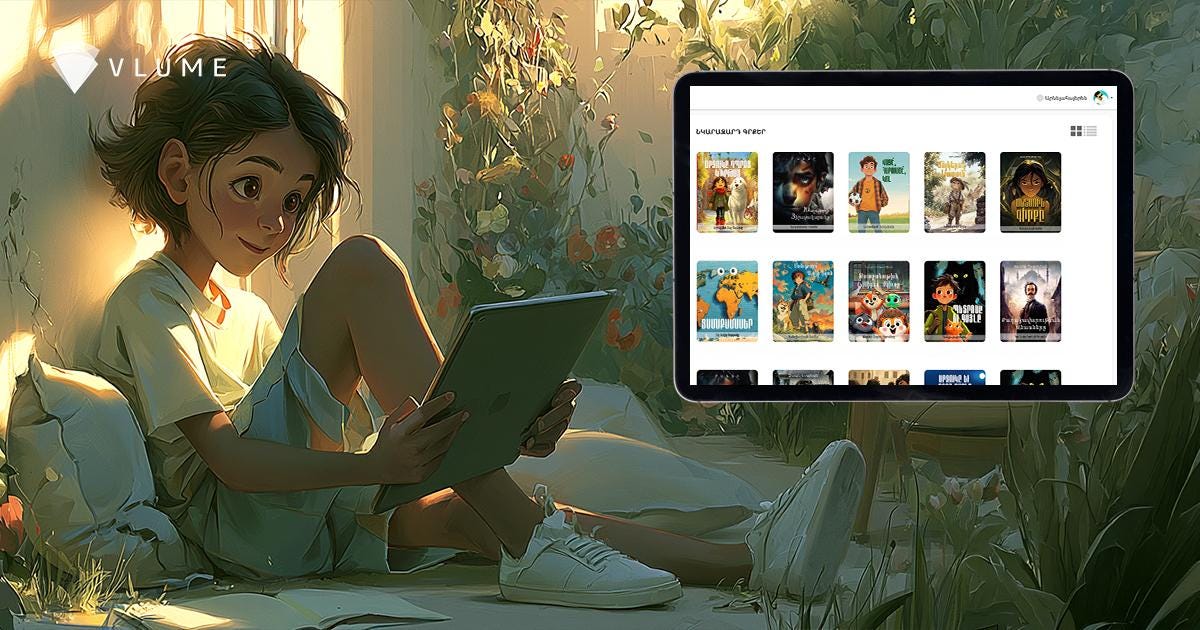
Vlume’s catalog, which pairs Armenian titles with translated international literature across both fiction and non-fiction, gives children something a single shelf rarely can: enough range to genuinely choose. Browsing, comparing, and deciding on a book are how children develop the sense that reading belongs to them, which is the condition the research identifies as most central to sustaining it. For diaspora children, the catalog does something further still: it puts Armenian books within reach that no physical bookstore in their city is likely to carry.
The platform is built around the conditions the research describes. Illustrated titles give younger readers a direct link between image and word, supporting vocabulary acquisition before fluency fully arrives. An embedded dictionary removes the friction of an unfamiliar word, keeping a reader moving without interrupting the story. The “Narrate for me” feature reads the text aloud, supporting pronunciation and comprehension. It also turns a book into something a parent and child can share together, which is the third condition the research names.
“The catalog spans classical and adapted literature, including Armenian Literary Gems, World Treasures, and The Chronicles of Narnia; illustrated series for readers aged 4 and up, among them Archoug the Big Brave Dog and Forest Heroes; non-fiction series covering science and the natural world, including Our Planet Earth and Fun and Physics; and My Favorite Sport for children who arrive at books through athletics. Treasure Island, translated and dubbed as an animated series, is quite literally something to watch with the family.”
Summer ends. What a child carries into September depends, more than most adults realize, on what they were reading in July.
Learn more about us by visiting link below.
